Understanding the wakes and vortices that jellyfish produce as they swim is crucial, according to Wu, et al. Particle image velocimetry (PIV) is a vital tool for studying flow phenomena and biomechanical propulsion. PIV essentially tracks tiny tracer particles suspended in water by illuminating them with laser light. The technique usually relies on hollow glass spheres, polystyrene beads, aluminum flakes, or synthetic granules with special optical coatings to enhance the reflection of light.
These particles are readily available and have the right size and density for flow measurements, but they are very expensive, costing as much as $200 per pound in some cases. And they have associated health and environmental risks: glass microspheres can cause skin or eye irritation, for example, while it’s not a good idea to inhale polystyrene beads or aluminum flakes. They are also not digestible by animals and can cause internal damage. Several biodegradable options have been proposed, such as yeast cells, milk, micro algae, and potato starch, which are readily available and cheap, costing as little as $2 per pound.
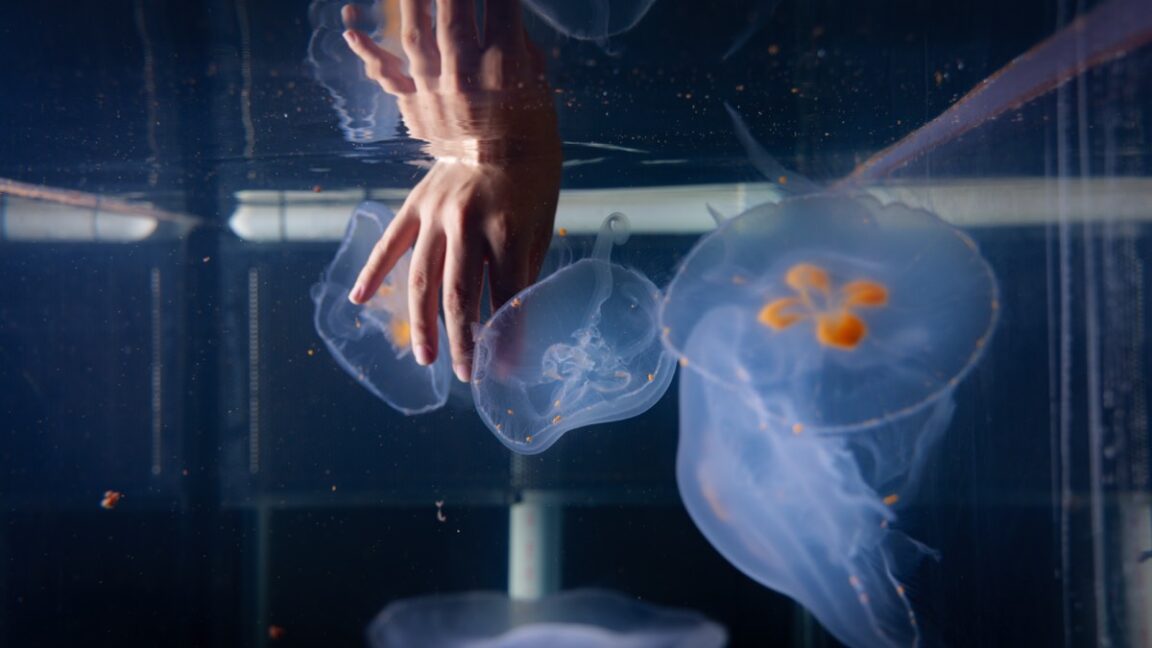
Wu thought starch particles were the most promising as biodegradable tracers, and decided to study several different kinds of starches to identify the best candidate: specifically, corn starch, arrowroot starch, baking powder, jojoba beads, and walnut shell powder. Each type of particle was suspended in water tanks with moon jellyfish, tracking their movement with a PIV system. They evaluated their performance based on the particles’ size, density, and laser-scattering properties.
Of the various candidates, corn starch and arrowroot starch proved best suited for PIV applications, thanks to their density and uniform size distribution, while arrowroot starch performed best when it came to laser scattering tests. But corn starch would be well-suited for applications that require larger tracer particles since it produced larger laser scattering dots in the experiments. Both candidates matched the performance of commonly used synthetic PIV tracer particles in terms of accurately visualizing flow structures resulting from the swimming jellyfish.
DOI: Physical Review Fluids, 2025. 10.1103/bg66-976x (About DOIs).


