[ad_1]
An unforeseen contribution from Juno
Juno, meanwhile, has been orbiting Jupiter since 2016, collecting information on the giant planet’s internal structure, magnetic field, and atmosphere.
“Everything is functional,” said Scott Bolton, the lead scientist on Juno, also from SWRI. “There’s been some degradation, things that we saw many years ago, but those haven’t changed. Actually, some of them improved, to be honest.”
The only caveat with Juno is some radiation damage to its camera, called JunoCam. Juno orbits Jupiter once every 33 days, and the trajectory brings the spacecraft through intense radiation belts trapped by the planet’s powerful magnetic field. Juno’s primary mission ended in 2021, and it’s now operating in an extended mission approved through the end of this month. The additional time exposed to harsh radiation is, not surprisingly, corrupting JunoCam’s images.
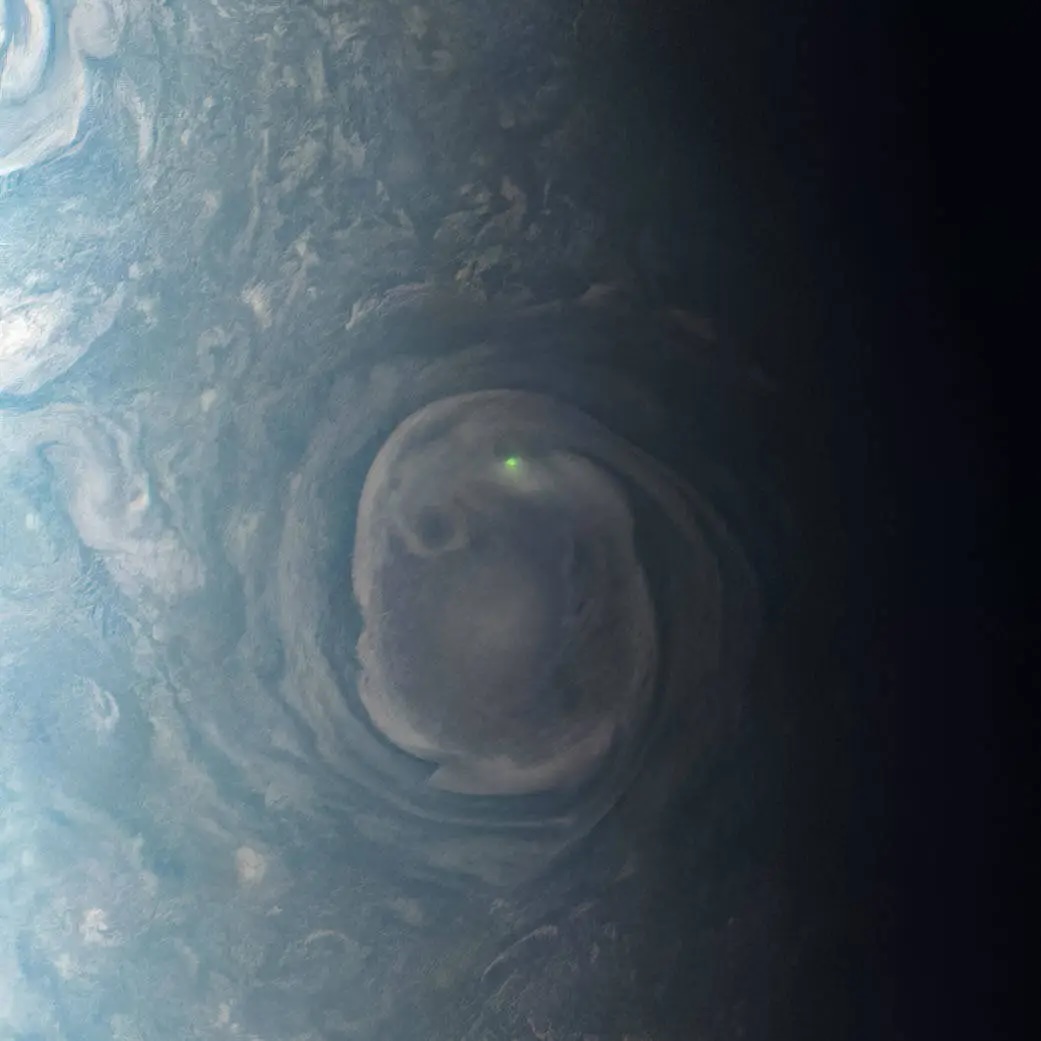
NASA’s Juno mission observed the glow from a bolt of lightning in this view from December 30, 2020, of a vortex near Jupiter’s north pole. Citizen scientist Kevin M. Gill processed the image from raw data from the JunoCam instrument aboard the spacecraft.
Credit:
NASA/JPL-Caltech/SwRI/MSSS Image processing by Kevin M. Gill © CC BY
In an interview with Ars, Bolton suggested the radiation issue creates another opportunity for NASA to learn from the Juno mission. Ground teams are attempting to repair the JunoCam imager through annealing, a self-healing process that involves heating the instrument’s electronics and then allowing them to cool. Engineers sparingly tried annealing hardware space, so Juno’s experience could be instructive for future missions.
“Even satellites at Earth experience this [radiation damage], but there’s very little done or known about it,” Bolton said. “In fact, what we’re learning with Juno has benefits for Earth satellites, both commercial and national security.”
Juno’s passages through Jupiter’s harsh radiation belts provide a real-world laboratory to experiment with annealing in space. “We can’t really produce the natural radiation environment at Earth or Jupiter in a lab,” Bolton said.
Lessons learned from Juno could soon be applied to NASA’s next probe traveling to Jupiter. Europa Clipper launched last year and is on course to enter orbit around Jupiter in 2030, when it will begin regular low-altitude flybys of the planet’s icy moon Europa. Before Clipper’s launch, engineers discovered a flaw that could make the spacecraft’s transistors more susceptible to radiation damage. NASA managers decided to proceed with the mission because they determined the damage could be repaired at Jupiter with annealing.
[ad_2]
Source link


