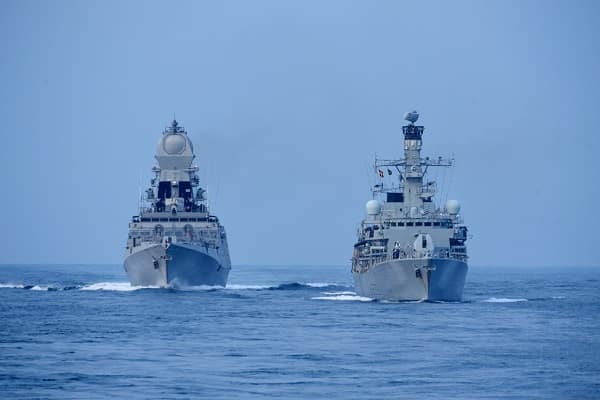
Prime Minister Keir Starmer is contemplating the deployment of British minehunting drones to assist in breaking Iran’s blockade of the Strait of Hormuz, particularly as Donald Trump urges allies to send naval forces to secure this critical oil route.
Currently, Tehran is obstructing traffic in the narrow waterway connecting the Persian Gulf and the Gulf of Oman.
This passage typically carries about 20 per cent of the world’s oil shipments. This disruption has already driven up global energy prices and raised concerns about a prolonged economic impact.
Western officials are increasingly worried that Iran may have begun deploying sea mines in the strait, a move that could further jeopardise commercial shipping and complicate any efforts to restore safe passage.
British military planners are examining the possibility of using minehunting drones to detect and neutralise explosives in the water.
These systems could be launched from the Royal Navy’s Mine and Threat Exploitation Group, which is already operating in the region, according to reports.
The autonomous drones are designed to identify and destroy naval mines without putting sailors in direct danger. They have been successfully used in similar operations to protect shipping lanes and could serve an important role if the situation in the strait worsens.
Additionally, a separate proposal being considered involves using interceptor drones developed in the UK for Ukraine to defend against Iranian-made Shahed drone attacks. While these systems were originally designed to counter the use of drones by Russia during the conflict in Ukraine, officials believe they could be adapted for use in the Gulf. However, discussions regarding this option are said to be at a much earlier stage than those surrounding the minehunting plan.
These developments come after Iran’s new supreme leader, Mojtaba Khamenei, vowed in his first public statement to keep the Strait closed as leverage against Washington.
On Saturday, Trump called for the UK and other allies—including China, France, Japan, and South Korea—to send warships to escort tankers and ensure the waterway remains open. Writing on his Truth Social platform, the former US president stated, “Hopefully China, France, Japan, South Korea, the UK, and others that are affected by this artificial constraint will send ships to the area so that the Hormuz Strait will no longer be a threat.” He also indicated that the United States would continue military actions against Iranian forces in the meantime, asserting, “One way or the other, we will soon get the Hormuz Strait open, safe, and free.”
Britain’s Ministry of Defence confirmed that “a range of options” is being considered to ensure that shipping can safely pass through the strait. The situation has become increasingly volatile since the conflict began, with multiple oil tankers coming under fire as they attempted to transit the waterway.
Trump has also threatened to destroy Kharg Island—the hub that manages the vast majority of Iran’s oil exports—if Tehran refuses to reopen the strait. He claims that American forces have already targeted military sites on the island in what he described as “one of the most powerful bombing raids in the history of the Middle East.”
If the blockade continues, analysts warn that disruption to global energy supplies could lead to further spikes in oil prices and exacerbate economic pressure worldwide.


