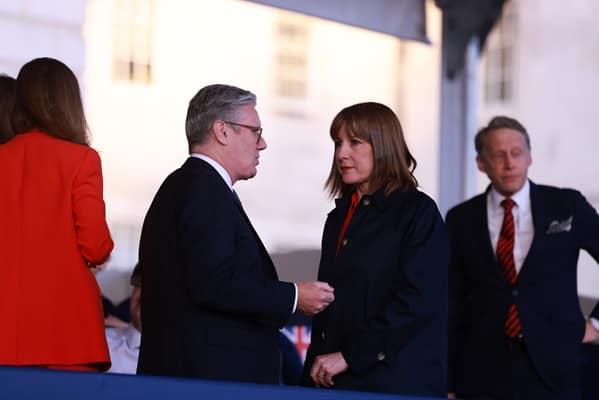
Britain has arrived at Davos in 2026 without a senior political voice on stage at precisely the moment global capital is deciding who still matters.
It’s striking because the stakes surrounding this year’s World Economic Forum are unusually concrete. Davos is taking place amid explicit tariff threats, heightened military posturing among allies, and a visible convergence between trade policy and territorial pressure.
Investors, executives, and policymakers are not debating abstract risks, instead they’re responding to developments already underway.
Neither the Prime Minister nor the Chancellor is delivering a keynote address. No senior UK government figure, as reported thus far, is using the main Davos platform to explain Britain’s position on tariffs, alliance stability, or the widening overlap between security and economic policy.
For a country that relies heavily on global capital, open trade, and geopolitical credibility, the absence carries weight.
Tariffs, unexpectedly, again, sit at the centre of the Davos agenda. Trade penalties are no longer treated as distant possibilities or rhetorical flourishes. They’re incorporated into market models, supply-chain planning, and sovereign risk assessments.
President Donald Trump’s approach to trade has reinforced that reality, with investors increasingly assuming that tariffs will be applied as leverage rather than restraint. Currency markets, equity valuations, and cross-border investment decisions are already reflecting those assumptions. We’ve seen this in real-time this week.
Greenland is the focal point of this shift. Reports on Monday say that Denmark has deployed additional troops and assets to Greenland, reinforcing surveillance and military presence in response to growing pressure surrounding the territory.
The move signals a transition from diplomatic tension to operational readiness. Markets interpret troop deployments differently from statements. Military posture alters risk calculations, particularly when combined with trade coercion.
The relevance for Davos is direct. Greenland represents the intersection of Arctic shipping routes, access to critical minerals, energy security, and alliance credibility.
When tariffs and territorial pressure converge around a NATO territory, investors reassess assumptions about stability across Europe and the North Atlantic. This reassessment is already now taking place in Davos meeting rooms.
Executives, from major global and influential boards, attending the forum are discussing how tariff escalation linked to strategic objectives affects supply-chain resilience, defence spending commitments, and capital allocation.
Asset managers are factoring alliance durability into sovereign exposure. Multinationals with transatlantic operations are revisiting contingency plans. These discussions are grounded in events unfolding now.
Britain has direct interests in each of these areas. The UK remains a NATO power, a major trading economy, and a global financial centre where geopolitical risk is priced daily.
Silence on the main Davos stage during a week defined by tariffs and military movements leaves investors to infer Britain’s stance indirectly. Inference increases uncertainty, and uncertainty carries a premium.
A keynote address at Davos serves a specific function. It allows a government to frame how markets should interpret risk, policy direction, and institutional reliability. It signals confidence, preparedness, and authority.
Countries competing for investment deploy their most senior figures for precisely that reason. France, Germany, and the United States understand the value of visible leadership when capital is reassessing exposure. Macron speaks today, Tuesday, for example.
The UK government’s presence through meetings and side events doesn’t substitute for that signal.
Attendance without a defining public intervention reads as caution at a moment when clarity is demanded.
Private discussions matter, yet they operate within a public narrative shaped by keynote moments. Davos sets the narrative tone for the year ahead.
Rachel Reeves’ engagement with business leaders is constructive, yet the absence of a keynote platform limits its impact. Investors want to hear how the UK intends to manage tariff risk, protect trade relationships, and respond to the fusion of economic and security pressures now visible in Greenland.
A chancellor’s address could have articulated fiscal discipline, regulatory stability, and strategic intent in response to those pressures.
Britain’s domestic economic backdrop sharpens the concern. Growth remains modest. Productivity lags comparable economies. Competition for foreign direct investment has intensified as governments deploy targeted industrial strategies and clearer policy frameworks.
Financial services face sustained competition from rival centres actively courting business with political backing.
Tariffs heighten those pressures. When trade barriers rise, capital becomes selective. Investors favour jurisdictions that demonstrate coherence and resolve. Davos provides an opportunity to project those qualities at scale. Britain has not done so.
The decision not to deliver a senior keynote cannot be dismissed as logistical. Davos is planned well in advance. Choices reflect priorities.
It seems the UK has declined to lead in public.
For a country seeking growth, investment, and influence, the decision to be silent on the public stage remains difficult to justify.


