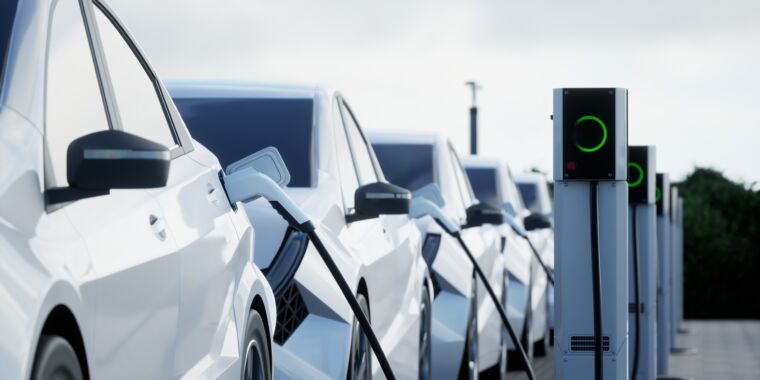
Getty Images/3alexd
Have electric vehicles been overhyped? A casual observer might have come to that conclusion after almost a year of stories in the media about EVs languishing on lots and letters to the White House asking for a national electrification mandate to be watered down or rolled back. EVs were even a pain point during last year’s auto worker industrial action. But a look at the sales data paints a different picture, one where Tesla’s outsize role in the market has had a distorting effect.
“EVs are the future. Our numbers bear that out. Current challenges will be overcome by the industry and government, and EVs will regain momentum and will ultimately dominate the automotive market,” said Martin Cardell, head of global mobility solutions at consultancy firm EY.
Public perception hasn’t been helped by recent memories of supply shortages and pandemic price gouging, but the chorus of concerns about EV sales became noticeably louder toward the end of last year and the beginning of 2024. EV sales in 2023 grew by 47 percent year on year, but the first three months of this year failed to show such massive growth. In fact, sales in Q1 2024 were up only 2.6 percent over the same period in 2023.
Tesla doesn’t break out its sales data by region anymore, but its new US registrations were down by as much as 25 percent, month on month, as its overall marketshare of EVs closes in on 50 percent this year; by contrast, Tesla was 80 percent of the US EV market in 2020. (Overall, Tesla’s global deliveries fell by 8.5 percent.)
The other sick patient in addition to Tesla is Volkswagen. Despite local production of the ID.4 crossover in Chattanooga, Tennessee, the brand saw EV sales fall by 37 percent in Q1. It has also abandoned plans to bring the ID.7 electric sedan to North America, and the long-awaited ID. Buzz microbus has yet to reach US showrooms more than eight years after it was first shown here.
But all this noise has been enough to spook executives into action. Both Ford and General Motors took the embarrassing step of rolling back their electrification goals, all but admitting they bet on the wrong horse. Instead of turning away from new internal combustion engine products, we’re set for a new flurry of hybrids—just don’t expect any of them to show up before 2026.
GM’s difficulty in ramping up its new family of EVs built around the UItium battery platform has been well-documented. The end of production of the Chevrolet Bolt, which sold for less than $30,000, didn’t help; with the little electric hatchback (and the slightly stretched Bolt EUV) no longer contributing to the sales charts, GM’s Q1 EV sales fell by 21 percent.
The problems with assembling Ultium cells into battery packs appears to be in GM’s past now. Cadillac Lyriqs are starting to become a common sight on the road, and GM CEO Mary Barra told Bloomberg that GM expects to build between 200,000 and 300,000 Ultium-based EVs this year, a huge increase over the 13,838 it managed to ship last year.
Meanwhile, Ford’s EV “slump” is nothing of the kind. In May, it sold 91 percent more F-150 Lightnings than last year. E-Transit sales were up 77 percent. And the Mustang Mach-E showed growth of 46 percent. In total, Ford’s EV sales for the first five months of this year were up 87.7 percent on 2023, helped no doubt by the company’s price cuts.
High double-digit sales growth (in Q1 2024) has also been occurring at Hyundai and Kia (up 56.1 percent), BMW (up 57.8 percent), Rivian (up 58.8 percent), Mercedes (up 66.9 percent), and Toyota (up 85.9 percent).
“As anticipated, Tesla’s sales took a hit, influencing the overall market dynamics. However, a few brands saw significant EV sales increases, achieving over 50 percent year-over-year growth,” said Stephanie Valdez Streaty, director of industry insights at Cox Automotive. “As noted in January, we are calling 2024 ‘the Year of More.’ More new products, more incentives, more inventory, more leasing and more infrastructure will drive EV sales higher this year. Even so, we’ll continue to see ups and downs as the industry moves toward electrification.”
“We view the current headwinds that EV sales are experiencing in the US and Europe as short-term in nature. The buildup of charging infrastructure, availability of affordable EV models with a fall in battery prices, combined with government regulations, will drive sustainable BEV growth in the long run,” said Cardell.


