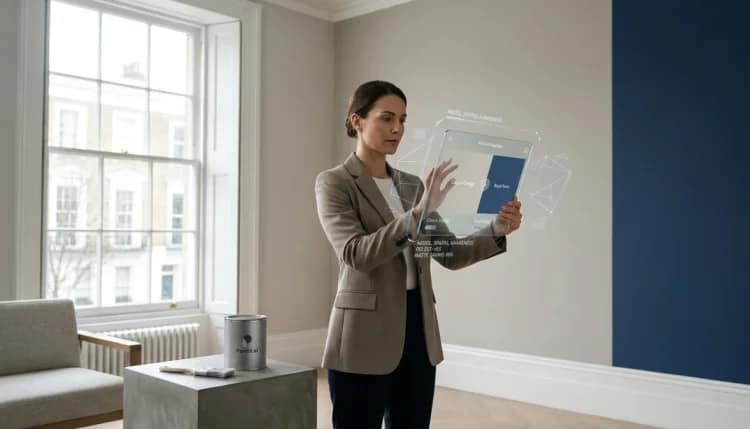
In the high-pressure environment of the London property market, every square foot counts-and every aesthetic choice carries a price tag. For property developers, landlords, and business owners in the City, the process of choosing a colour scheme is no longer just about personal taste; it is a calculated business decision. A single mismatched shade can lead to weeks of rework, wasted materials, and extended vacancies. However, a new technological shift is occurring. The emergence of the AI-driven paint visualiser is redefining the economics of renovation, allowing stakeholders to move from expensive guesswork to data-backed certainty in seconds.
Key takeaways for property professionals
- Error Mitigation: An AI paint visualiser reduces the risk of costly repainting by providing hyper-realistic previews under specific lighting conditions.
- Time-to-Value (TTV): Professional-grade design concepts that once took weeks now happen in real-time, accelerating the “ideas-to-action” pipeline.
- Enhanced ROI: Strategically chosen palettes can increase rental yields and property resale value by up to 5%, according to recent market insights.
- Sustainability: Digital testing eliminates the need for millions of physical plastic sample pots, aligning with corporate ESG (Environmental, Social, and Governance) goals.
The £50bn renovation risk: Why “guesswork” no longer works in the City
London’s renovation market is one of the most expensive in the world. With the average cost of high-end decorating in zones 1 and 2 reaching record highs, the “permanence anxiety” felt by property owners is justified. Traditional methods-buying five different sample pots, painting patches on a wall, and squinting at them in different lights-are not only archaic but commercially inefficient.
The problem with traditional samples is their inability to show scale and context. A 20cm patch of “Slate Grey” looks very different when applied to a 40-square-meter Victorian drawing room. For business owners, this uncertainty creates a friction point that delays projects. In 2026, the strategy has shifted: smart money is spent on visualisation before a single brush is dipped in pigment.
Evolution of Design: Beyond the Traditional Sample Pot
The waste problem in the UK decorating industry is staggering. Every year, millions of litres of unused paint and thousands of plastic testers end up in landfills. For a city obsessed with sustainability and carbon footprints, this “analog” waste is a significant hurdle.
This is where the transition to AI house paint technologies becomes a game-changer. Unlike basic filters, a modern AI paint visualiser understands spatial geometry. It recognises how shadows fall in a narrow Soho loft versus a bright Greenwich conservatory. By creating a high-fidelity “digital twin” of a space, tools like Paintit.ai allow for an unlimited number of iterations without a single drop of waste.
The EIS framework: Engineering empathy and intuition into every pixel
At the heart of this technological revolution is the EIS framework: Empathy, Intuitiveness, and Seamlessness. This isn’t just about “AI magic”; it is about a product architecture designed to care for the user’s cognitive load and emotional investment in their space.
- Empathy: The system must understand that a London office isn’t just a room; it’s a productivity engine. The AI recognises cultural and stylistic nuances, offering palettes that reflect a brand’s identity or a home’s history.
- Intuitiveness: Business owners don’t have time to learn complex CAD software. The interface must be a “unified design ecosystem”-one workspace where you type a prompt and see an instant transformation.
- Seamlessness: This is the “Flow State”. It is the uninterrupted loop of type → see → tweak → buy.
Step-by-step strategy: Using an AI paint visualiser for maximum asset value
Whether you are preparing a flat for the premium rental market or redesigning a boutique office in Shoreditch, the process follows a logical, frictionless path.
- Contextual Upload: Provide the AI with a photo of the existing space. The system automatically selects the best model for the task-be it a global redesign or targeted object-level edits.
- Prompt-Driven Exploration: Instead of browsing endless catalogs, you use natural language. “Apply a warm, professional Scandi-style palette to these walls”.
- Real-Time Iteration: Within seconds, the paint visualiser generates variants. You can tweak the lighting, change the floor material, or swap out furniture in one continuous screen.
- The Commerce Handoff: Once the visual is perfect, the “Seamlessness” pillar kicks in. The AI recommends real furniture and paint SKUs, moving you from an idea to an actionable shopping cart in minutes.
ROI benchmark: Traditional decorating vs. AI-driven design
| Criteria | Traditional Decorating | AI-Assisted (Paintit.ai) |
| Time to Concept | 5-10 days (samples + drying) | < 60 seconds |
| Cost of Iteration | High (£30-£100 in testers/time) | Zero (included in sub) |
| Accuracy | Low (Scale and light issues) | High (Spatial awareness) |
| Friction | High (Multi-tab/store hopping) | Low (Unified workspace) |
| Sustainability | Low (Chemical/plastic waste) | High (100% Digital) |
The sustainability dividend: Solving the UK’s paint waste crisis
For London businesses looking to improve their Green credentials, digital-first design is an easy win. By virtually testing colours, you ensure that only the necessary amount of paint is ordered and applied. This “precision design” approach reduces the environmental impact of the renovation cycle. Paintit.ai is not just a render tool; it is a relationship with your space that respects the environment.
Summary: Your property as a strategic asset
In 2026, aesthetics are a business asset. The ability to visualise and iterate in real-time gives London property owners a massive competitive advantage. You are no longer at the mercy of poor lighting or small paint chips. You are in command of your space’s rhythm and ROI.
Design should be an accessible form of personal and professional expression. By embracing a paint visualiser that prioritises the EIS framework, you can turn any renovation project into a seamless, inspiring journey from a simple idea to a finished, high-value reality.


