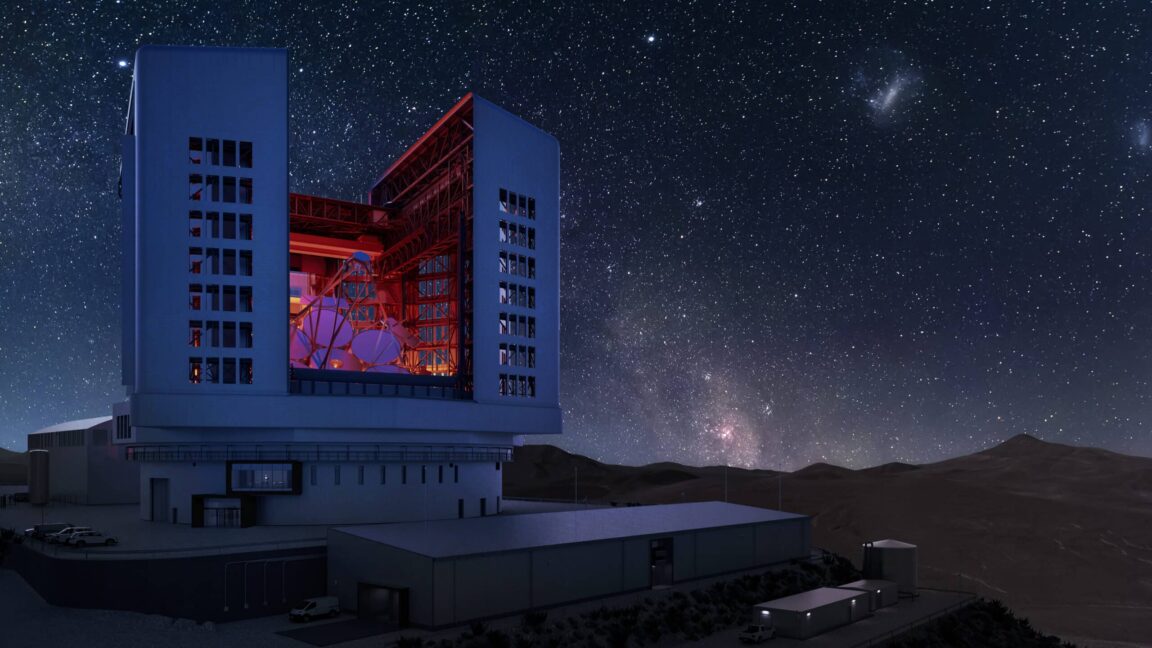
I have been writing about the Giant Magellan Telescope for a long time. Nearly two decades ago, for example, I wrote that time was “running out” in the race to build the next great optical telescope on the ground.
At the time the proposed telescope was one of three contenders to make a giant leap in mirror size from the roughly 10-meter diameter instruments that existed then, to approximately 30 meters. This represented a huge increase in light-gathering potential, allowing astronomers to see much further into the universe—and therefore back into time—with far greater clarity.
Since then the projects have advanced at various rates. An international consortium to build the Thirty Meter Telescope in Hawaii ran into local protests that have bogged down development. Its future came further into question when the US National Science Foundation dropped support for the project in favor of the Giant Magellan Telescope. Meanwhile the European Extremely Large Telescope (ELT) has advanced on a faster schedule, and this 39.5-meter telescope could observe its first light in 2029.
This leaves the Magellan telescope. Originally backers of the GMT intended it to be fully operational by now, but it has faced funding and technology challenges. It has a price tag of approximately $2 billion, and although it is smaller than the European project, the 25.4-meter telescope now represents the best avenue for US-based astronomy to remain competitive in the field.
Given all of this, I recently spoke with University of Texas at Austin astronomer Dan Jaffe, who is the new president of the telescope’s executive team, to get an update on things. Here is a lightly edited transcript of our conversation.
Ars Technica: What should we know about the Giant Magellan Telescope?
Dan Jaffe: This is going to be one of the premier next-generation optical infrared telescopes in the world. It will give the United States astronomical community access that helps us to be a leading nation in this field, inspire students to go into science and engineering, and really enrich the human experience through the new knowledge that we get about the nature of the universe. So I think it covers both this kind of aspiration that we have to enrich humanity in some way, to help foster the future economy by bringing more people into these technical fields, and also by driving technology in some areas. The kinds of work we’re doing on adaptive optics, for example, in building sensitive detector systems and spectrometers, drive the frontier of what you can do with these systems.


