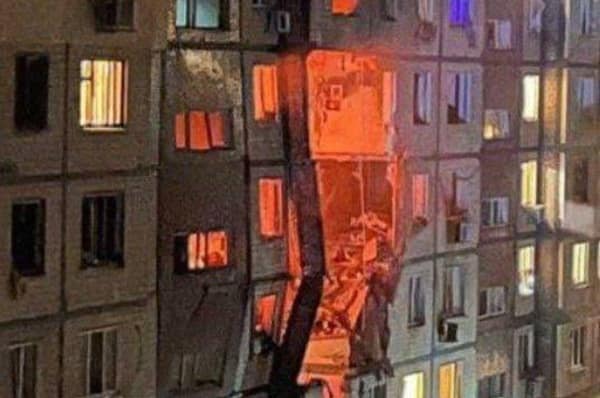
Last night, Dnipro, like so many cities across Ukraine, was shaken awake by missiles and drones.
The Armageddon flashes of red and orange broke through the curtains, made even more vivid by the blackout and the unnatural silence of curfew.
In a city roughly the size of north London, split by a river wider than the Thames, the effect is haunting.
This barely makes headlines in the West anymore but it still produces raw footage for social media though, still reminding everyone that this is a brutal, industrial war being fought in real time, also exposing the gap between what actually matters and what mainstream media chooses to focus on.
More importantly, it risks obscuring a deeper truth: this war is no longer only about what happens on the battlefield. It is about perception, legitimacy, competence, and which side looks like it belongs to the future.
In that contest, the contrast between Ukraine and Russia has never been starker.
Look at the two systems side by side. Ukraine’s leadership, whatever its flaws, looks like a modern state under pressure: younger, more media-literate, more adaptable, and far more comfortable operating in a world where information moves faster than tanks. Figures like President Volodymyr Zelenskyy (48), digital transformation minister Mykhailo Fedorov (35), and former military intelligence chief Kyrylo Budanov (39) embody that shift: a leadership cohort shaped by post-Soviet Ukraine and fluent in modern media and technology.
Russia’s leadership, by contrast, increasingly resembles a museum exhibit: ageing, insular, and reflexively reaching for the tools of the past—the Soviet past. President Vladimir Putin (73), Foreign Minister Sergei Lavrov (75), and Chief of the General Staff Valery Gerasimov (70) are products of a different era, one where control of information meant control of reality.
The numbers tell part of the story. The average age of Ukraine’s cabinet is dramatically lower than that of Russia’s senior leadership circle, which is dominated by men who came of age in the late Soviet system and never really left it behind. That generational gap shows up in how each side thinks, communicates, and reacts to crisis—and increasingly in how each side understands what power even looks like in a 21st-century war.
Ukraine’s political and military leadership understands that this war is fought simultaneously on three fronts: the physical battlefield, the diplomatic arena, and the information space. Russia’s leadership, meanwhile, increasingly behaves as if only the first one really matters, and as if the other two can be “managed” the way they were in the 1980s: by restricting access, silencing platforms, and pretending that fewer voices means fewer problems.
In other words, stuck in the 80s. Hence the return of what can only be called the Soviet playbook.
Over the past weeks, Russia has moved to throttle or shut down Western social media platforms one by one. Twitter, YouTube, Discord, and now Google services and Telegram, the single most important communications platform inside Russia itself have all been targeted, slowed, blocked, or squeezed. Officially, this is framed as “security” or “sovereignty.” In reality, it’s an admission of failure.
When a state starts pulling plugs, it’s not projecting strength. It’s conceding that it no longer controls the narrative in an open environment.
For years, the Kremlin’s propaganda machine was genuinely formidable. It didn’t just lie, it built entire parallel realities, repeated them often enough, and relied on a mix of cynicism, fear, and apathy to keep the system running. But propaganda only works when it can plausibly compete with reality, and the reality of this war, casualties, economic strain, mobilisation anxiety, broken promises, and the sheer longevity of a conflict sold as a “three-day operation”, has become too big to hide, even for the Kremlin’s juggernaut.
Even the most polished disinformation can’t explain why, years later, Russia still hasn’t achieved its core political objectives in Ukraine. It can’t explain why regional budgets are strained, why mobilisation keeps returning in new forms, or why the list of “temporary difficulties” keeps getting longer. So instead of fixing the story, the Kremlin is trying to shrink the audience.
That’s not confidence. That’s triage for a system that knows it’s failing.
Ukraine, meanwhile, has gone the opposite way. It has leaned into visibility, not away from it. As a friend of mine once said, “the most successful people lean into problems, not away from them.” Ukraine has made mistakes, plenty of them, but it has also learned fast, and on the job. Its officials communicate directly, argue in public, get challenged by journalists, and operate in a political culture that, even under wartime pressure, still looks recognisably modern.
The country’s leadership understands that credibility is a weapon, and that in a long war, trust, at home and abroad, is a form of strategic depth.
This is why nights like last night in Dnipro matter in two different ways. Militarily, they are about air defence, damage, recovery, and the grim arithmetic of interception rates and impact sites. Politically and psychologically, they are about narrative endurance. Russia still wants these attacks to signal inevitability: that Ukraine will eventually be worn down, that resistance is futile, that time is on Moscow’s side.
But the reality is different. Spring is weeks away. Warmer temperatures are coming, and Putin will have spent billions, again, on a recycled plan that failed last winter, and the winter before that.
The problem for the Kremlin is that time is also exposing its own stagnation.
The more Russia leans into censorship, the more it confirms that it is losing the argument, especially when it targets its own largest social media platform, one the Russian military itself relies on. The more it talks about “information sovereignty,” the more it reveals fear of information itself, all while hypocritically depending on Western technology, and the more it resurrects Soviet-era methods of control, the clearer it becomes that this is not a state confident in its future, but one retreating into its past.
Has Ukraine already “won” this war?
Not in any simple, military sense. Wars like this don’t end because one side wins the narrative. They end because power, resources, alliances, and realities on the ground converge. But in the battle over legitimacy, modernity, and credibility, Ukraine is in a stronger position today than it was a year ago, arguably even two years ago, and Russia is most certainly in a weaker one.
That’s why the Kremlin is reaching for the off switch.
“Have you tried turning it off and on again?” is a joke from the IT world, a last-ditch fix when systems stop behaving. In Russia’s case, it’s becoming a governing philosophy: if reality doesn’t cooperate, block it. If the story doesn’t sell, silence the marketplace. If the future looks uncomfortable, retreat into the past.
The trouble is, you can’t firewall your way out of a war. And as my friend once put it: “how do you land the shitshow you started?”


