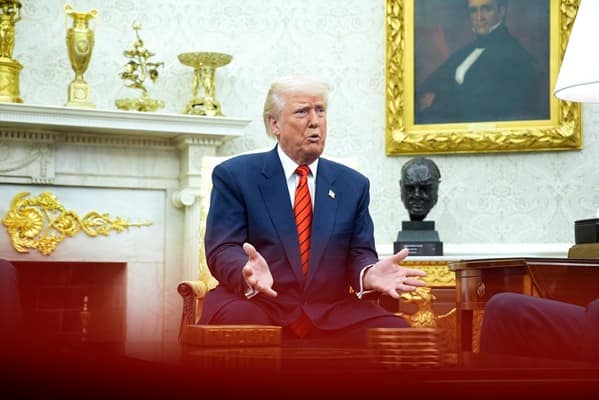
Donald Trump has recently voiced sharp criticism of Britain’s military contributions, particularly within the context of the NATO alliance.
During a televised Cabinet meeting at the White House, the US President expressed his dissatisfaction with the United Kingdom’s perceived hesitance to provide robust support for American operations in the Middle East.
His comments came in light of escalating tensions with Iran, where he specifically referenced a missile threat to Diego Garcia, a strategic U.S. military base in the Indian Ocean.
Trump said: “They shot at the now-famous island that the UK was too afraid to give us because they didn’t want to get involved.”
He then suggested that Britain’s reluctance to engage more proactively in military affairs signals a broader unwillingness to support U.S. objectives. “But we don’t want to get dragged into their wars either,” he added, indicating a complicated view of the US’s role in global conflicts.
Trump said he was “very disappointed” with NATO, adding: [Some nations] actually made a statement, a couple of them, that we want to get involved when the war is over. No, you’re supposed to get involved when the war’s beginning, or even before it begins.”
He then took aim at the Royal Navy, Trump said: “We had the UK say – this is three weeks ago – we’ll send our aircraft carriers, which aren’t the best aircraft carriers, by the way. They’re toys compared to what we have.”
These remarks mark a notable escalation in Trump’s critical rhetoric toward a key ally, as he explicitly called into question Britain’s commitment to Operation Epic Fury, an operation designed to counter threats in the region.
His frustration seems to stem not just from what he perceives as a lack of military support, but also from a broader disappointment in NATO itself.
Trump lamented that he was “very disappointed” in the alliance, raising alarms about the future of Western unity, especially amid rising global tensions and security challenges.
Such comments are likely to intensify concerns in London regarding the reliability of U.S. security assurances.
They could also jeopardise the future of transatlantic defence cooperation, as the UK grapples with questions about its role and the extent to which it can rely on American support in times of crisis.
The implications for military collaboration and strategic alignment between the US and the UK could be significant, shaping both nations’ defence policies in the future.


