[ad_1]
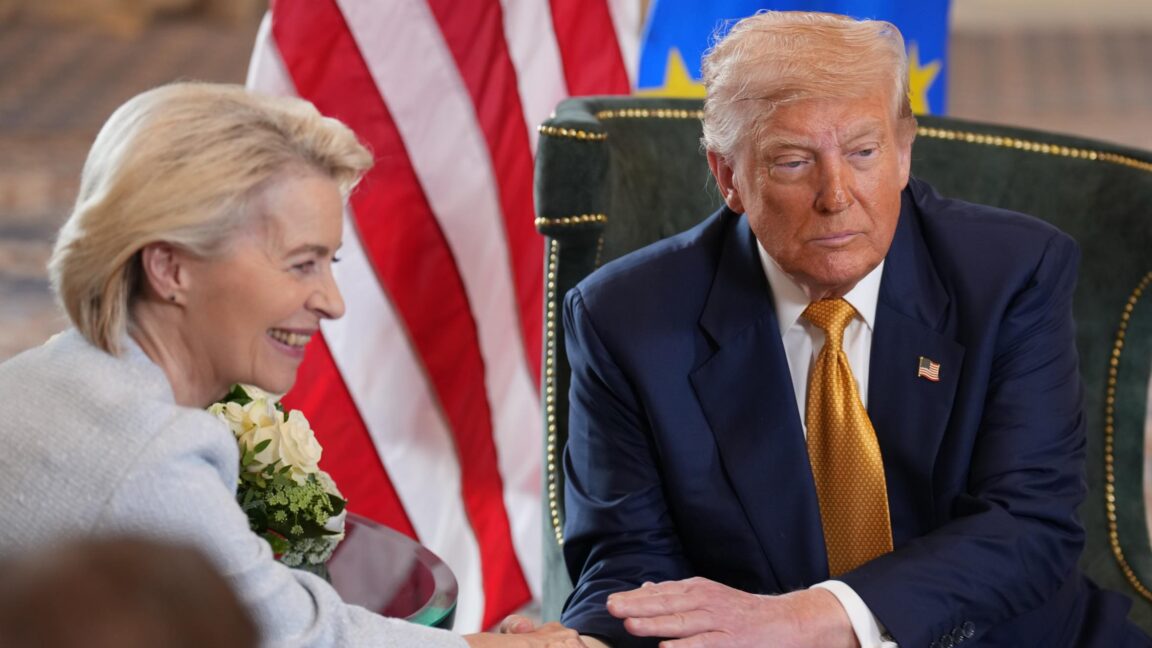
We asked the White House and European Commission for more details today and will update this article with any new information.
If the White House fact sheet’s reference to network usage fees has at least some truth to it, it may refer only to a tentative agreement between Trump and von der Leyen. The overall trade deal, which includes a 15 percent cap on tariffs for most EU exports into the US, is not final, as the European Commission pointed out in its announcement.
“The political agreement of 27 July 2025 is not legally binding,” a European Commission announcement said. “Beyond taking the immediate actions committed, the EU and the US will further negotiate, in line with their relevant internal procedures, to fully implement the political agreement.”
Big Tech hopeful that usage fees are dead
The European Union government sought public input on network fees in 2023, drawing opposition from US tech companies and the Biden administration. While European ISPs pushed for new fees from online companies that accounted for over 5 percent of average peak traffic, the Biden administration said the plan “could reinforce the dominant market position of the largest operators… give operators a new bottleneck over customers, raise costs for end users,” and undermine net neutrality.
As tech industry analyst Dean Bubley wrote today, the White House statement on network usage fees is vague, and “the devil is in the detail here.” One thing to watch out for, he said, is whether Europe prohibits back-door methods of charging network usage fees, such as having the government regulate disputes over IP interconnection.
Bubley speculated that the EC might have “received a boatload of negative feedback” about network usage fees in a recent public consultation on the Digital Networks Act and that the trade deal provides “a nice, Trump-shaped excuse to boot out the whole idea, which in any case had huge internal flaws and contradictions—and specifically worked against the EU’s own objectives in having a robust AI industry, which I’d wager is seen in Brussels as much more important.”
[ad_2]
Source link


