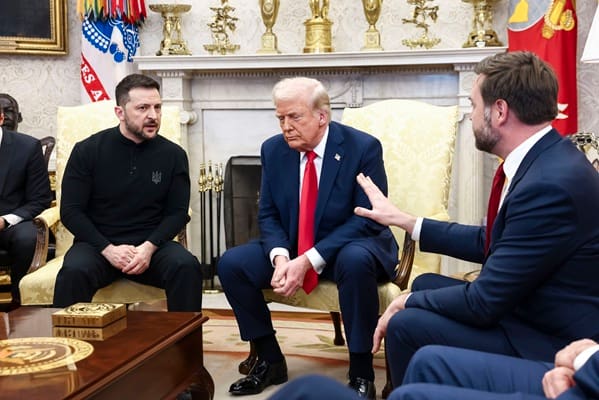
Donald Trump’s latest threat to halt weapons supplies to Ukraine has sent predictable shockwaves through Western capitals. But strip away the headline, and the reality is more complex and far more revealing.
The claim stems from Trump’s warning that US arms deliveries could be cut unless European allies support American efforts to reopen the Strait of Hormuz, alongside clear frustration at Europe’s reluctance to participate in the US-led war with Iran.
At face value, it sounds like a decisive break with Ukraine. In reality, it looks far more like leverage, born out of frustration within the White House and reflected in increasingly mixed messaging from an administration still relying heavily on social media to shape policy narratives.
What the US is actually supplying
Under Trump, the United States is no longer the primary financier of Ukraine’s war effort, it is the supplier.
The key mechanism is the Prioritised Ukraine Requirements List (PURL), a NATO-backed scheme in which European allies pay for US-made weapons that are then transferred to Ukraine. Trump has been explicit: Washington is “selling” weapons to NATO rather than donating them, effectively turning support into a transactional model.
While the US remains central to Ukraine’s military supply chain, particularly for high-end systems such as air defence, artillery, and precision munitions, the financial burden has shifted to Europe. Put simply: if Europe is paying, it owns the effort.
So when Trump threatens to “stop supplying weapons,” he is not pulling the plug on aid in the traditional sense, he is threatening again to disrupt a supply chain that Europe is largely funding.
Is aid actually stopping? Not yet
Despite the rhetoric, deliveries are still ongoing. NATO officials confirm that weapons under the PURL mechanism continue to flow to Ukraine, even as resources are quietly being rebalanced toward the Middle East.
What is happening is pressure, and the numbers explain why.
In just the first days of the Iran conflict, US and allied forces burned through over 800 Patriot interceptor missiles, countering more than 500 ballistic missiles and thousands of drones launched by Tehran.
By comparison, Ukraine has received roughly 600 Patriot missiles across four years of full-scale war with Russia.
In other words, the Middle East has consumed more high-end air defence in days than Ukraine has had available for years.
This is why the Pentagon is now considering diverting critical air defence systems away from Ukraine. This is not purely political, it is a supply constraint, one that was entirely predictable given the scale of operations against Iran. The speed at which stockpiles have been depleted has left many analysts questioning the planning behind the campaign.
Ukraine, by contrast, has fought a sustained missile war for over four years, absorbing daily waves of cruise missiles, ballistic strikes, and Shahed-type drones. That fight has been managed through conservation: layered defence, selective interception, and increasingly, cheaper counter-drone solutions, an area in which Ukraine has become a global leader.
The Iran theatre is fundamentally different: short, intense, and resource-heavy. The US and its allies are firing premium interceptors at scale, something Ukraine has never had the luxury to do.
This is not a shutdown—it is a squeeze.
Sanctions waivers and strategic contradictions
At the same time, Trump has signalled a softer line on Russia, including sanctions flexibility that risks increasing Moscow’s revenue streams.
The contradiction is becoming increasingly difficult to ignore.
On one hand, the US remains the backbone of Ukraine’s weapons supply chain. On the other, policy shifts risk fuelling the very war those weapons are meant to contain. The question now being asked more openly is simple: how does Russia continue to benefit from decisions taken in Washington?
This is not a strategy aligned with Western interests, particularly as Russia continues to support Iran, including through intelligence-sharing that directly impacts US and allied forces.
Iran, Hormuz, and the bigger picture
The timing of Trump’s threat is no coincidence.
The US is now heavily engaged in a widening conflict with Iran, where disruption in the Strait of Hormuz is already shaking global energy markets.
If Iran consolidates control over international shipping lanes, the consequences are immediate:
- Oil prices surge
- Global trade tightens
- Tehran gains significant economic leverage
Combined with rising energy revenues, both Iran and Russia stand to benefit, and already are.
That is the uncomfortable truth.
While Washington pressures allies over Ukraine, the broader geopolitical landscape is shifting in ways that strengthen both Moscow and Tehran simultaneously, with very little being said.
The bottom line
Trump’s threat to cut weapons to Ukraine is not, yet, a policy shift, it is a negotiating tool however, something we have seen before.
But it exposes a deeper reality:
- The US is no longer carrying Ukraine financially
- Europe is underwriting the war effort
- American strategic focus is drifting toward Iran
- Strategic contradictions are beginning to surface
Ukraine is still being supplied, but it is no longer the centre of gravity, while Vladimir Putin stands as a clear beneficiary of the wider US-led conflict with Iran.
And in war, once you are no longer the priority, the clock starts ticking.


