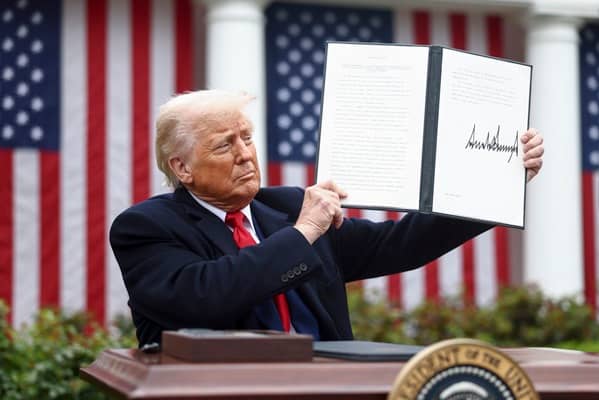
President Trump has signed an executive order extending the U.S.–China tariff truce by 90 days, delaying previously scheduled escalation to November 10, 2025.
The extension pauses a surge in reciprocal tariffs, ensuring that tariffs on Chinese imports remain at 30% while U.S. exports to China continue to face 10% tariffs, saving businesses from sudden, steep duty hikes.
The announcement was closely followed by a positive response across global stock markets, with equities across Asia and Europe climbing following the announcement, boosted by reduced trade tensions and optimism over negotiation progress.
U.S. retailers also welcomed the move, gaining certainty ahead of the critical holiday inventory period and a chance to stabilise disrupted supply chains.
Administrations on both sides called it a pragmatic move, while the U.S. maintains its demand for larger soybean purchases and restrictions on Russian oil imports, China reiterated its commitment to trade dialogue and stability.
With the pause in tariffs in place, companies dependent on U.S.–China trade ecosystems now have a renewed, but brief, window to reassess inventory strategies, pricing models, and compliance protocols before the truce expires. However, economists caution that unless long-term deals are reached, the extension merely delays another round of trade friction.
Mark McCarthy, Chief Revenue Officer at Basware said, “Trade wars and tariff uncertainty introduce volatility into the global economy. For major enterprises, especially those with complex supply chains or international footprints, this creates hesitation around IT spending. CIOs and CFOs may want to delay large IT investments, reassess strategic priorities, and scrutinize every dollar of spend. Organizations are working on contingencies, but in a turbulent environment, smart enterprises don’t stop investing, they get more focused on their spending and look for greater ROI on every purchase. This means looking to drive even more cost efficiency and investing in areas to mitigate.
Supply chains are not as nimble as we saw during the pandemic, so CIOs and CFOs will also be considering suppliers that have the skills to handle the complex tax and tariff landscape. Combining technology solutions with tax compliance and skills will be vital in the near future as these tariffs come into effect.”
On the compliance front, this deferral reconfigures timelines for risk assessments and enforcement planning. Financial crime units and regulatory teams must now recalibrate monitoring systems to account for evolving border measures and adapt enforcement protocols in real time to avoid potential gaps in oversight.
Michael Joseph, Compliance Expert at Napier AI, said, “Fluctuating tariffs, while designed to serve economic and national security objectives, have created unintended consequences. As supply chains reorganize in response, new vulnerabilities for money laundering and other financial crimes have emerged. Our research shows that money laundering and terrorist financing cost the US economy over $600 billion per year on average.”
“Tariff differentials between countries create strong incentives for trade diversion and misrepresentation. When goods face a 10% tariff from one country but potentially up to 145% from another, criminal organizations can exploit these differences through invoice manipulation, falsifying country of origin documentation, or routing shipments through third countries to conceal their true origin. These techniques are hallmarks of trade-based money laundering but can become more difficult to detect during periods of extreme volatility.”
Businesses across sectors must remain vigilant and are advised to use this pause to solidify short-term continuity while preparing for the possibility of further shifts in tariffs if negotiations falter.


