
[ad_1]
Pluto must harbor a wellspring of internal heat to keep from freezing solid, something researchers didn’t anticipate before the arrival of New Horizons.
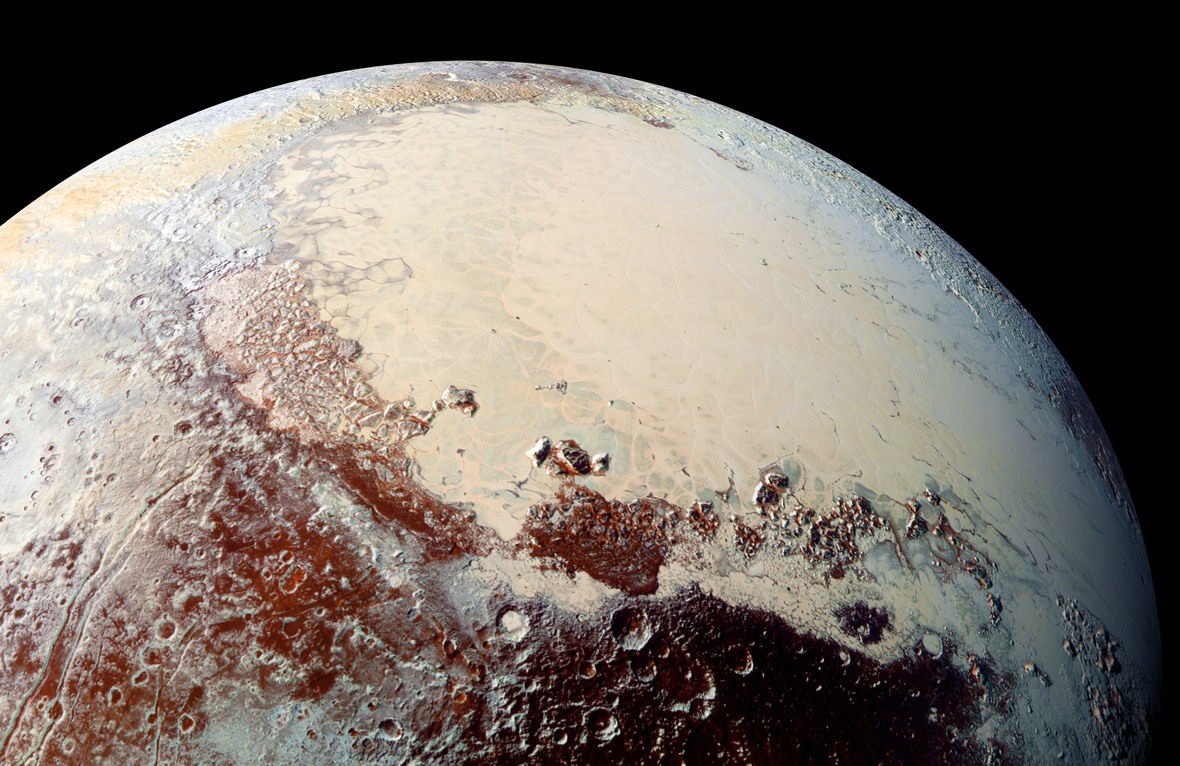
New Horizons revealed Pluto as a mysterious world with icy mountains and very smooth plains.
Credit:
NASA
So, what is Pluto’s ocean like? How thick are Pluto’s ice sheets? Are any of Pluto’s suspected cryovolcanoes still active today? And, what secrets are hidden on the other half of Pluto?
These questions, and more, could be answered by an orbiter. Some of the scientists who worked on New Horizons have developed an outline for a conceptual mission to orbit Pluto. This mission, named Persephone for the wife of Pluto in classical mythology, hasn’t been submitted to NASA as a real proposal, but it’s worth illustrating the difficulties in not just reaching Pluto, but maneuvering into orbit around a dwarf planet so far from the Earth.
Nuclear is the answer
The initial outline for Persephone released in 2020 called for a launch in 2031 on NASA’s Space Launch System Block 2 rocket with an added Centaur kick stage. Again, this isn’t a realistic timeline for such an ambitious mission, and the rocket selected for this concept doesn’t exist. But if you assume Persephone could launch on a souped-up super heavy-lift SLS rocket in 2031, it would take more than 27 years for the spacecraft to reach Pluto before sliding into orbit in 2058.
Another concept study led by Alan Stern, also the principal investigator on the New Horizons mission, shows how a future Pluto orbiter could reach its destination by the late 2050s, assuming a launch on an SLS rocket around 2030. Stern’s concept, called the Gold Standard, would reserve enough propellant to leave Pluto and go on to fly by another more distant object.
Persephone and Gold Standard both assume a Pluto-bound spacecraft can get a gravitational boost from Jupiter. But Jupiter moves out of alignment from 2032 until the early 2040s, adding a decade or more to the travel time for any mission leaving Earth in those years.
It took nine years for New Horizons to make the trip from Earth to Pluto, but the spacecraft was significantly smaller than an orbiter would need to be. That’s because an orbiter has to carry enough power and fuel to slow down on approach to Pluto, allowing the dwarf planet’s weak gravity to capture it into orbit. A spacecraft traveling too fast, without enough fuel, would zoom past Pluto just like New Horizons.
[ad_2]
Source link


