[ad_1]
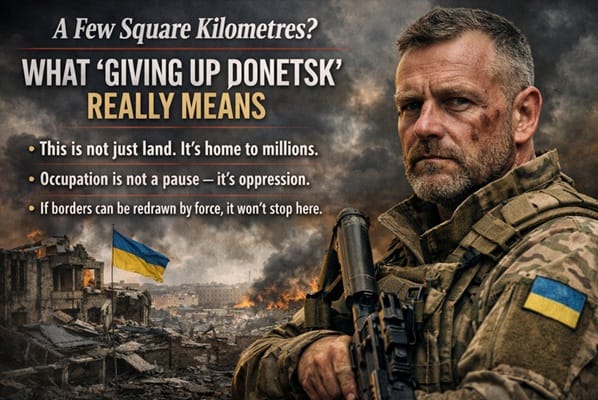
There’s a phrase that gets thrown around far too casually lately, that Ukraine and Russia are “haggling over a few square kilometers.” So when JD Vance says something like that, it lands as if this war is a border dispute, a negotiable inconvenience, a matter of lines on a map that can simply be redrawn to stop the bloodshed.
But that framing is not just wrong, it’s dangerously dishonest, and in my view, absolutely 100% on purpose. It’s not a mistake or naivety, and I’ll explain why in this piece, but let’s start here: I don’t see Donetsk as “a few square kilometers.” I see it as home, along with millions of others.
Mariupol wasn’t just a city to me, it was where I built a life, it was where my wife had a home, and where we met. It wasn’t just bricks and mortar, but everything that came with it: photographs, memories, years of work, and what should have been her future.
That home is gone now, stolen. Not metaphorically, but literally occupied. We’ve seen it on satellite imagery, we know people are living there, but I can’t disclose how we know for security reasons and the risk it may pose to friends still connected to the area.
Strangers.
Living in a life that was never theirs, but ours.
My wife has now lost two homes to this war, the first in Crimea, the second in Mariupol. Two lives erased, families split, overwritten by an imperialist occupying force that doesn’t just take land, it takes identity, history, and dignity.
Russia hasn’t just made it impossible for us to return, it has made it impossible to exist there as who we were. I was illegally put through a sham court by a puppet state backed by Russia, tortured, beaten, starved, and forced into a trial by public opinion. I was made to sit in front of state-run Russian media like RT to justify Putin’s narratives, then handed a death sentence, for defending my home as a Ukrainian Marine.
My wife, a deminer working to clear mines left from Russia’s war since 2014, was labelled a terrorist by the same system. A civilian clearing explosives, branded as a threat. That alone tells you everything about the nature of this occupation.
That is what “giving up Donetsk” actually means.
I use our story as one example, but there are over 6 million internally displaced Ukrainians and millions more refugees abroad, according to United Nations estimates. Each with their own version of this story, many far worse than mine. At least I still have my arms, my legs, and most importantly, each other.
And Mariupol itself? The human cost is staggering. Ukrainian officials estimate that at least 25,000 civilians were killed during the siege, a conservative figure, with many believing the true number is far higher due to mass graves and destroyed records.
Even before the war, Mariupol, like much of Ukraine, struggled with corruption, oligarchic influence, and post-Soviet decay. But that was a fight Ukrainians were actively engaged in fixing as we see now. What Russia brought was not “order” or “liberation”, it replaced flawed governance with outright occupation, repression, and destruction.
“Just giving up Donbas” — and I don’t even like using that term; Donetsk and Luhansk say it plainly — means accepting that theft works.
Exactly what I wrote yesterday, you naturally start asking: who exactly are you working for?
When even Trump can’t convince his own MAGA base anymore, something’s shifted. https://t.co/0Vc9h2GFHy pic.twitter.com/wF0LUfYbXl
— Shaun Pinner (@ShaunPinnerUA) April 10, 2026
It means legitimizing a system where violence redraws ownership, where families are erased and replaced, where your past can be occupied as easily as your property. It tells every Ukrainian who has lost something that their loss is permanent and acceptable, but if you think it stops at homes, you haven’t been paying attention.
Occupation is not neutral and it’s not a pause in the conflict but a continuation of it by other means.
In Russian-occupied territories, we’ve already seen filtration camps — I was in one — along with forced deportations and the systematic dismantling of Ukrainian identity. People disappear, children are taken and re-educated, language, culture, and history are rewritten. It’s documented reality, recognised by multiple international organisations with Putin himself is now indicted by the ICC.
And now Ukrainians in those territories are being forcibly conscripted into the very army that invaded them.
Think about that.
A Vice President of the United States, from a country that defines itself as the home of the free, now framing this as something negotiable, something minor, because that’s what this rhetoric enables: more death, more internment, more theft, more lives crushed.
You lose your home, your country is taken from you and then you are forced to fight against your own people under the flag of the state that destroyed your life. That is the future being suggested when people talk about “just giving up” Donetsk, but there’s a broader strategic blindness in that argument too. Russia does not operate on the basis of satisfaction and in my experience, it operates on momentum.
Every time it consolidates territory, it pushes further and we saw it after Crimea in 2014, we saw it in Donbas, and we saw it again in 2022, when the idea that Russia would stop if accommodated was exposed as a fantasy.If Ukraine gives up Donetsk, it doesn’t end the war, it resets it. It gives Russia time to regroup, rearm, and entrench. It validates invasion, occupation, and consolidation as an effective strategy, and once that lesson is learned, it will be applied again, maybe in Odesa, and certainly beyond Ukraine.
Because this war was never just about Donetsk. It’s about whether borders in Europe, and globally, still mean anything at all.
If Russia is allowed to keep what it has taken, then the post-World War II order built on the principle that territory cannot be acquired by force, starts to unravel, and that doesn’t just affect Ukraine. It sends a message to every authoritarian state watching: if you are willing to absorb the cost, you can take what you want.
Look at the strain already on Western unity now, the shifting narratives, and more importantly, the political voices framing this war on Russia’s terms. When figures like JD Vance reduce it to “a few square kilometers,” they aren’t misunderstanding the situation, they are reframing it.
Because to understand what’s really at stake is to understand that this isn’t a land dispute, it’s a question of principle, security, and precedent, and from where I stand, having been through captivity, torture, and everything that comes with it, there is no illusion about what occupation means.
It means brutality without accountability.
It means your life is no longer yours.
It means your home becomes someone else’s.
So when people ask why Ukraine doesn’t just give up Donetsk, the answer is simple:
Because it’s not just land.
It’s lives, it’s homes and it’s people like you and me. It’s everything that’s already been taken, and everything that will be taken next if the world decides that this is acceptable.
And from where I’m standing, that’s not a negotiation.
That’s surrender.
[ad_2]
Source link


