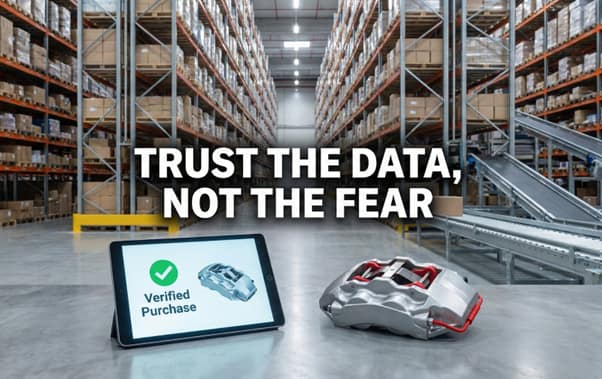
For business owners and fleet managers, vehicle maintenance is a constant financial pressure. As we move through 2026, the shift towards digital procurement is undeniable, yet a persistent hesitation keeps many buyers stuck in the past.
There is a widespread belief that procuring digitally means risking counterfeit goods or inferior quality. But is this caution actually protecting your drivers, or is it simply draining your budget? We analysed recent market data to see if the “trust gap” is based on facts or outdated habits.
The real numbers behind the “Trust Gap”
The headline statistic often circulating in industry whispers is that “only 39% of buyers trust online parts”. However, a closer look at the numbers suggests this is a misinterpretation of consumer satisfaction tiers.
According to recent surveys conducted by AUTODOC, the reality is far more positive. The data reveals that 39% of customers rate the overall quality of its parts as ‘very high‘, while an additional 35% rate it as ‘high‘.
AUTODOC
When combined, nearly three-quarters of buyers report a positive experience with component quality. The “39% trust” figure appears to refer strictly to those who give a perfect score, rather than a lack of trust from the majority.
Nevertheless, scepticism remains. This hesitation is not unfounded; the internet is vast, and the risk of counterfeit components is a legitimate concern for any fleet manager responsible for driver safety.
This concern is backed by hard data. According to a recent report by the European Union Intellectual Property Office (EUIPO), the automotive sector loses approximately €2.2 billion annually due to counterfeit tyres and batteries alone. This statistic underscores a critical reality: the ‘fear’ of fakes isn’t paranoia, but it is a rational response to a market flooded with illicit goods. The solution, however, is not to avoid digital procurement, but to choose partners who guarantee the supply chain.
Spotting the fakes: Price vs. value
For businesses, the allure of online purchasing is often the price. However, industry experts warn that there is a strict limit to how low prices can go before quality is compromised.
Alexandru Lazariuc, a Technical Specialist in auto parts selection at AUTODOC, offers a stark warning for buyers who prioritise cost over authenticity.
“A counterfeit is €20, not €100,” Lazariuc explains. “If a part is too cheap, it’s 99% fake. Always check the packaging and documentation.”
This insight is crucial for procurement officers. A discount of 10–15% suggests a competitive supply chain, whereas a discount of 80% suggests a product that may fail under stress. Lazariuc advises that the packaging often tells the tale – blurry fonts, no hologram stickers, or generic boxes are immediate red flags.
The logistics factor: Why warehousing matters
Quality is not just about the manufacturing of the part; it is about how it is stored and handled. In 2026, the distinction between a reliable vendor and a risky one often comes down to the logistics infrastructure.
Historically, damage during transit or poor storage conditions contributed to the perception of “low quality” online parts. To combat this, major European players have invested heavily in infrastructure. For instance, AUTODOC recently opened a state-of-the-art warehouse in Ghent, Belgium in 2025.
For UK and European businesses, these strategic hubs are vital. They reduce the time parts spend in transit and ensure components are handled in climate-controlled, professional environments rather than damp drop-shipping containers.
Social proof: The market reality
The ultimate litmus test for any online retailer in 2026 is social proof. A look at the leading platforms confirms that the trust gap is closing rapidly across the board.
For example, AUTODOC – Great Britain currently holds a Trustpilot rating of 4.3 out of 5 stars, based on over 15,852 reviews. This high volume of positive feedback indicates that for the vast majority of buyers, the system works reliably.
This trend of high trust is not unique to one brand; it reflects a maturing UK market. Regional stores like Euro Car Parts also maintain high standards, boasting “Excellent” Trustpilot scores within the same range.
The data from these major players suggests that the “wild west” era of online parts is over. Whether sourcing from AUTODOC or major stores like Euro Car Parts, the established market leaders are delivering consistent quality that contradicts the “low trust” narratives.
Conclusion: Buying safely in 2026
The idea that online parts are inherently risky is no longer supported by the data. With nearly 75% of users rating quality as either high or very high, the market has matured.
However, the remaining scepticism serves a healthy purpose as it keeps buyers vigilant. To ensure that your fleet remains safe and cost-effective, follow these three rules:
- Audit the price: if a deal looks too good to be true (e.g., €20 for a €100 part), walk away.
- Verify the infrastructure: buy from suppliers with established logistics hubs to ensure handling quality.
- Check the reputation: use platforms like Trustpilot to verify that other business owners are satisfied. Look for ratings above 4 stars with thousands of reviews.
By applying these standards, business owners can stop fearing fakes and start optimising their fleet costs.


